Insulating Oklahoma City Homes, From Heritage Hills to Gaillardia
Oklahoma City covers so much ground that a single answer to “what insulation do I need” is not useful. An early-1900s two-story in Heritage Hills, a 1970s ranch in Quail Creek and a 2000s house near Deer Creek lose comfort in completely different places. This page walks through the city by era so you know what is typical for your street before anyone climbs into the attic.
At a Glance
- Permits issued by
- City of Oklahoma City
- From central OKC
- In the city itself
- Main ZIP codes
- 73102, 73103, 73106, 73112, 73118, 73120, 73134, 73142, 73162
The Homes and Buildings in Oklahoma City
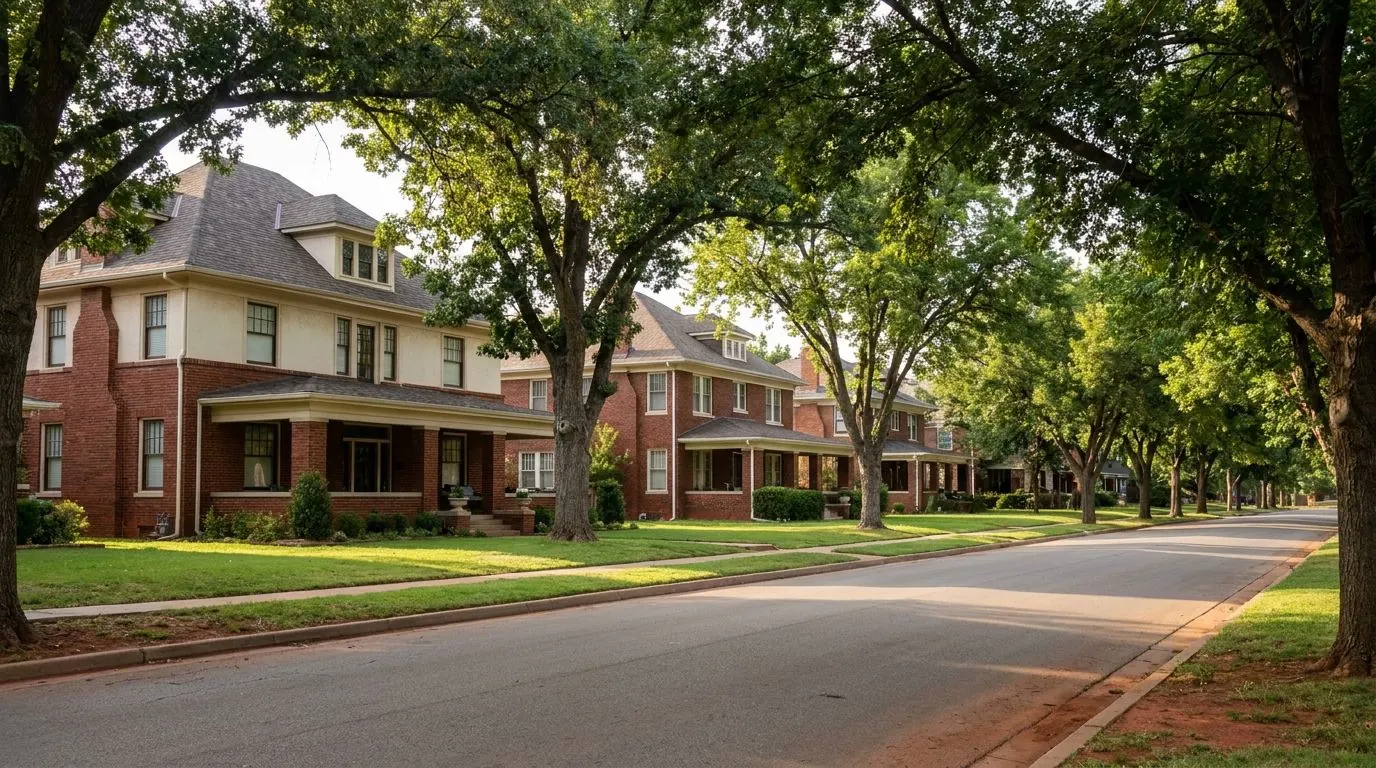
The near-downtown historic districts hold the city’s oldest houses. Heritage Hills and Mesta Park are mostly early-1900s homes, many of them two-story with plaster walls, and a short drive north, Crown Heights and Edgemere Park add bungalows and Tudors from roughly the 1920s through the 1940s. Most of these sit on pier-and-beam framing over a vented crawl space rather than a slab. The attics were often insulated decades after construction, if at all, and the walls are frequently empty. Before anyone blows material into a closed wall here, an electrician needs to confirm there is no live knob-and-tube wiring, and suspect vermiculite gets tested first.
Moving outward, the post-war and 1960s–70s stock changes the picture. Neighborhoods like Quail Creek in northwest OKC are largely ranch and larger single-story homes on slabs, with brick veneer walls and an attic that carries the furnace or air handler and most of the ductwork. Insulation levels in those attics commonly reflect the expectations of the era and have often settled further since. Recessed cans, open top plates and a pull-down stair with no weatherstrip let attic air into the living space. That leakage is a common reason the back bedrooms run hot by late afternoon.
The far northwest, Gaillardia and the Deer Creek side of the city, was built largely from the 1990s onward, and those houses fail differently. They are bigger two-story homes with complex rooflines, bonus rooms over the garage, knee walls against a hot attic and long duct runs to the far rooms. The attic depth may be fine on paper while the bonus room still will not cool in July. Downtown, Midtown and Deep Deuce infill adds townhomes, apartments and mixed-use buildings, where the questions shift to sound between units, duct insulation and commercial firestopping.
Neighborhood Notes
Heritage Hills
Early-1900s two-story homes with plaster walls, older attics and crawl spaces. Attic air sealing and a top-up come first; wall work waits for an electrician’s check on old wiring and, for any exterior access, the preservation process.
Mesta Park
Similar age to Heritage Hills, with many homes on pier-and-beam over vented crawls. Humid summer air condenses on cool ducts and floor framing below, so crawl space encapsulation and duct sealing are common conversations here.
Crown Heights and Edgemere Park
Bungalows and Tudors from roughly the 1920s through the 1940s. Low attics with tight access, cold floors in winter cold snaps and uninsulated walls. Dense-pack is possible in many of them, but only after the cavities and wiring are checked.
Capitol Hill and the older south side
Early to mid-1900s homes. The attic is usually the best value, followed by closing up the crawl space or floor. Where rodents have fouled the old insulation, a full removal comes before re-insulating.
Quail Creek
Largely 1960s–70s ranch and larger single-story homes with attic HVAC and older insulation levels. Sealing the HVAC platform, return plenum and recessed lights before blowing in fill is the order we follow here.
Gaillardia and the Deer Creek area
Two-story homes from the 1990s onward with bonus rooms, knee walls and complex rooflines. Thermal imaging on a summer afternoon often points to the bonus room floor or the knee walls rather than the main attic.
Midtown and Deep Deuce
Urban infill and mixed-use buildings. The work is usually sound isolation between units, duct and pipe insulation, and firestopping in rated assemblies, coordinated with the general contractor and design team.
Permits in Oklahoma City
Authority having jurisdiction: City of Oklahoma City
Inside city limits, the City of Oklahoma City, through its Development Services department, is the authority for building permits. Insulation that is part of a permitted addition, remodel or new build is inspected as part of that permit. Whether a stand-alone attic top-up or crawl space job needs one is the City’s call, and we will not guess for you. Historic preservation review can apply to exterior changes in districts such as Heritage Hills, which matters if wall insulation would be installed from outside. Because the city spans parts of Oklahoma, Canadian, Cleveland and Pottawatomie counties, an address just outside the limits may be unincorporated, so check with that county. Nichols Hills and The Village are separate cities with their own offices.
What Oklahoma City Homes and Buildings Need Most
Attic Air Sealing & Penetration Proofing
Hand-sealing attic penetrations, top plates, duct boots and the HVAC platform.
Crawl Space Encapsulation
Sealed ground liners and perimeter wall foam for damp OKC crawl spaces.
Blown-In Cellulose Attic Top-Ups
Borate-treated cellulose blown over thin attic fill toward an R-49 benchmark.
Dense-Pack Cavity Injection
High-density cellulose injected into closed walls through small drilled holes.
Bonus Rooms Over Garages
Fixes for a bonus room that won’t cool in summer or stay warm underfoot in winter.
0.5lb Open-Cell Spray Foam
Roof-deck foam around attic HVAC, vaulted ceilings and quieter walls.
Close to Oklahoma City
Kickingbird and Oak Tree to newer two-story homes and east-side acreages.
Ranch homes and post-2013 rebuilds along I-35 between OKC and Norman.
1940s–60s ranch homes beside Tinker Air Force Base, plus Soldier Creek.
Route 66 core homes and big newer subdivisions on the west side.
Insulation in Oklahoma City: Questions
Can the plaster walls in my Heritage Hills or Mesta Park house be insulated without tearing them out?
I live in Nichols Hills. Is that covered by the Oklahoma City permit office?
My Quail Creek ranch has the AC in the attic. Should I foam the roof deck or add more blown insulation?
Insulation Work in Oklahoma City?
Tell us the address and what is going on. Spray Tech Insulation works across Oklahoma City and the surrounding area, and we will tell you what the job needs before we price it.