Direct-to-Metal Warehouse Spray Foam for Oklahoma City Commercial Bays
Bare steel roofs turn a warehouse into an oven in July and drip on stock and equipment on humid nights. We spray closed-cell foam directly to the underside of corrugated roof decks and wall panels in Oklahoma City bays, then protect it as the IBC and the foam’s evaluation report require.
The Problem It Solves
An uninsulated steel roof is a large, thin radiator. On an Oklahoma summer afternoon the deck can run far hotter than outdoor air, and that heat radiates straight down onto racking, pallets, workers and whatever is stored below. In a conditioned bay, rooftop units run against that load for most of the day, and in an unconditioned warehouse the space under the roof can become hard to work in by early afternoon.
The opposite problem arrives on cool, humid nights and in winter. Warm, moist air inside the building, from people, forklifts, open dock doors, wet product or gas-fired heaters, meets steel that has cooled to below its dew point. Water condenses on the underside of the deck and on the purlins, then drips. Owners call it rain inside the building. It spots finished goods, soaks cardboard, rusts fasteners and racking, and puts slick spots on the slab where forklifts turn.
Many older metal buildings have a thin vinyl-faced blanket draped over the purlins under the deck. Over time the facing tears, the tabs pull loose and the fiberglass compresses at every purlin, so the insulation keeps less heat out than it did when new. Air and moisture get behind torn facing and condense on the steel anyway, and the wet blanket sags further. Adding more of the same rarely fixes it, because the problem is air and moisture reaching the steel, not only too little R-value.
How It Works
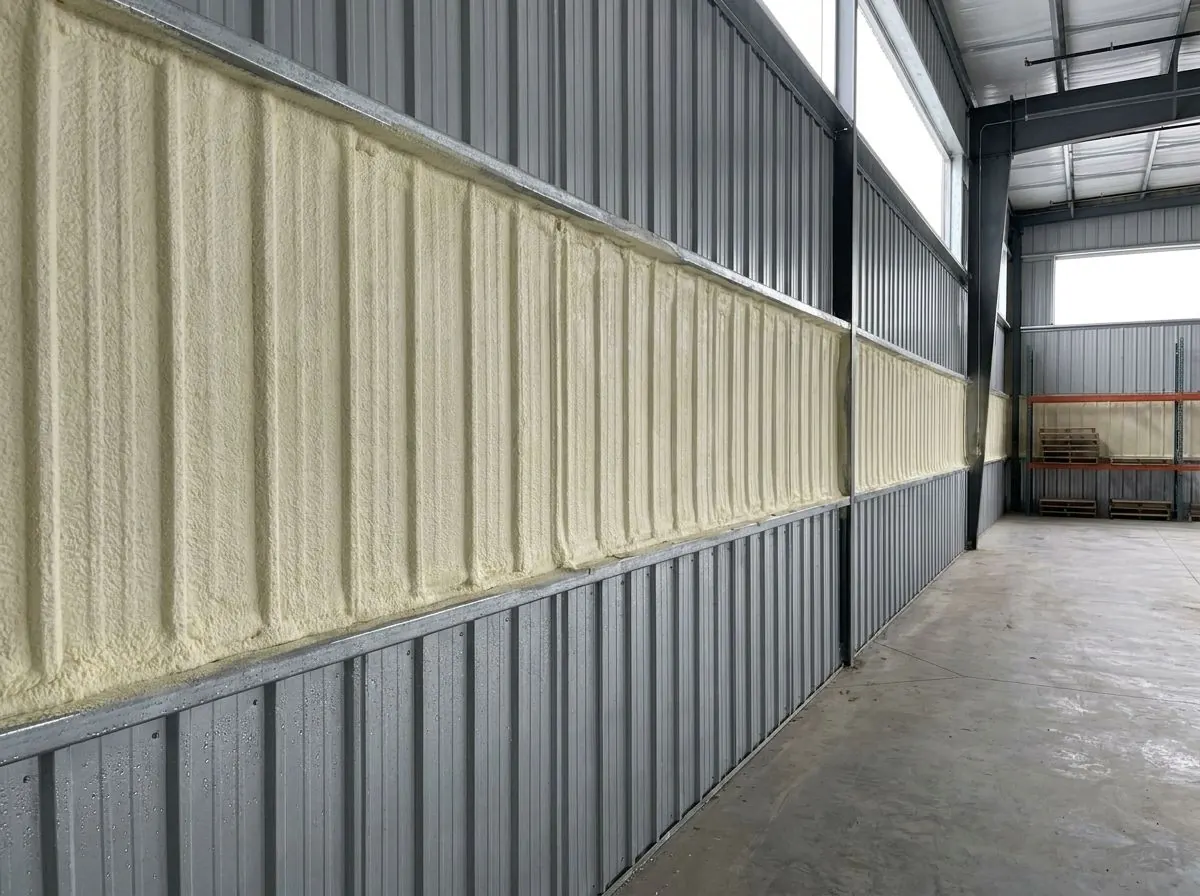
Closed-cell foam sprayed directly to the underside of the metal bonds to the steel and fills the corrugations, so there is no gap behind it for humid air to reach. It insulates the deck, seals the lap joints and fastener holes where outdoor air and dust leak in, and moves the condensing surface from the cold steel to the inside face of the foam, which stays near room temperature. That is what stops the drip. Because the foam resists water uptake, it holds up on steel where a fibrous blanket would soak and sag.
In summer the same layer slows the heat moving down from a sun-baked deck, so the space under the roof stays closer to the conditions the HVAC or ventilation was sized for. On wall panels it does the same against afternoon sun. The foam goes on in measured lifts, and its thickness is chosen for the R-value target, the condensation risk of the use and the protection the evaluation report allows over it.
How the Job Runs, Step by Step
Inspect the steel and the use of the building
We look at the deck profile, panel laps, existing insulation, roof leaks and rust, and ask what happens in the bay: stored product, humidity sources, heaters, dock door traffic and any food or chemical use. Active roof leaks are fixed by the roofer before foam goes on, because foam hides a leak rather than stopping it.
Remove old blanket and prepare the metal
Torn or wet faced blanket is removed and bagged where the scope calls for it. Steel is cleaned of oil, dust and loose rust, and primed if the foam manufacturer requires it for that substrate. Foam sprayed over oily or dusty metal can let go later, so this step is not skipped to save a day.
Plan lifts, zones and the schedule
Bays are split into zones so operations can continue in the rest of the building. Stock, racking and equipment under the work zone are moved or covered, sprinkler heads, lights and sensors are masked, and lift paths are planned around rack rows.
Spray in lifts with ventilation running
Foam goes on in passes no thicker than the manufacturer’s per-pass limit, which controls heat of reaction, until the specified thickness is reached. The zone is ventilated during spraying and cure, and re-entry follows the manufacturer’s re-occupancy time, commonly about a day.
Apply the protection and close out the zone
The thermal barrier or accepted coating named in the foam’s evaluation report is applied at its required thickness, checked with a wet-mil gauge where it is a coating. We record foam and coating thicknesses for the owner and the inspector before the next zone starts.
What Decides the Specification
Thickness depends on what the building is for. A dry storage warehouse with no conditioning needs enough foam to stop condensation and take the edge off summer radiant heat. A conditioned flex bay, a showroom or a light manufacturing space needs more, set against an energy target the design professional names where the work is part of permitted construction. Interior humidity matters as much as temperature: a bay with wet product, washdown, cooking or many occupants needs thicker foam so the inner face stays above dew point.
Protection is the other driver, and it is not optional. The IBC requires foam plastic inside commercial buildings to be separated from the interior by a thermal barrier, and the foam’s evaluation report lists what qualifies for that product: gypsum board, specific intumescent coatings at stated thicknesses, or other tested assemblies. A coating accepted with one foam is not automatically accepted with another, so the foam and coating are chosen together. Occupancy, sprinkler coverage and the fire official’s review can affect the answer, which is why we confirm the protection before spraying.
Oklahoma Code Notes
Commercial and industrial buildings in Oklahoma are governed by the International Building Code and the commercial energy provisions the local jurisdiction enforces. For foam plastic inside these buildings, the IBC requires a thermal barrier between the foam and the interior unless the foam’s evaluation report, commonly an ICC-ES report, shows an accepted alternative such as a tested coating assembly. Coating-over-foam assemblies are commonly qualified under ICC-ES AC377. The report names the foam thickness, the coating, its thickness and any limits on use, and the building official confirms it on site. Inside Oklahoma City limits that is the City of Oklahoma City’s Development Services; in Moore, Midwest City or Yukon it is that city’s building department. Whether a retrofit needs a permit is a decision for that department, not for us.
General guidance only. The city building department and the product’s own evaluation report decide what applies to your job.
Around Oklahoma City
The warehouse and distribution buildings along the I-35 and I-40 corridors are the core of this work: large-span steel roofs over racked storage, cross-dock bays with doors open for much of the day, and older buildings where the original faced blanket has torn and sagged. Interstate frontage means long, exposed elevations that take full afternoon sun and constant wind, and many of these buildings change tenants and uses over their lives, so an insulation approach chosen for dry storage may not suit the next occupant.
Around Midwest City, the commercial and light industrial area near Tinker Air Force Base mixes older steel buildings, contractor yards and supply businesses, where condensation on stock and tools is a common complaint. Smaller flex bays in Moore and Yukon, often a showroom or office up front with a steel shop behind it, are another fit, and the work can be scheduled after hours so the business keeps operating. Older buildings in both areas often still carry their original faced blanket, which usually comes out first.
Often Done Alongside
Intumescent Thermal Barrier Coating
Listed intumescent coatings over exposed foam where drywall won't work.
Pole Barns & Agricultural Shops
Spray foam that stops roof steel sweating in barns, shops and steel buildings.
2lb Closed-Cell Spray Foam
Dense 2 lb foam for crawl walls, rim joists, concrete and steel buildings.
Where We Do This Work
Warehouse Foam: Questions We Get
Can you spray a warehouse roof while we stay open?
Will spray foam stop our metal roof from dripping?
Do we have to cover the foam with drywall?
Should the old faced blanket come out first?
How do you work out what my home actually needs?
Considering Warehouse Foam?
Tell Spray Tech Insulation about the job. We will look at it, tell you whether warehouse foam is the right fix, and price it in writing.