Mobile and Manufactured Home Insulation in Oklahoma City: Belly Repairs and Skirting Seals
In a manufactured home, the floor is often the weakest part of the envelope. Torn belly board, sagging insulation and wind under the skirting leave cold floors in winter and frozen water lines in an arctic outbreak. We repair the bottom board, re-insulate the belly and seal the skirting where its design allows.
The Problem It Solves
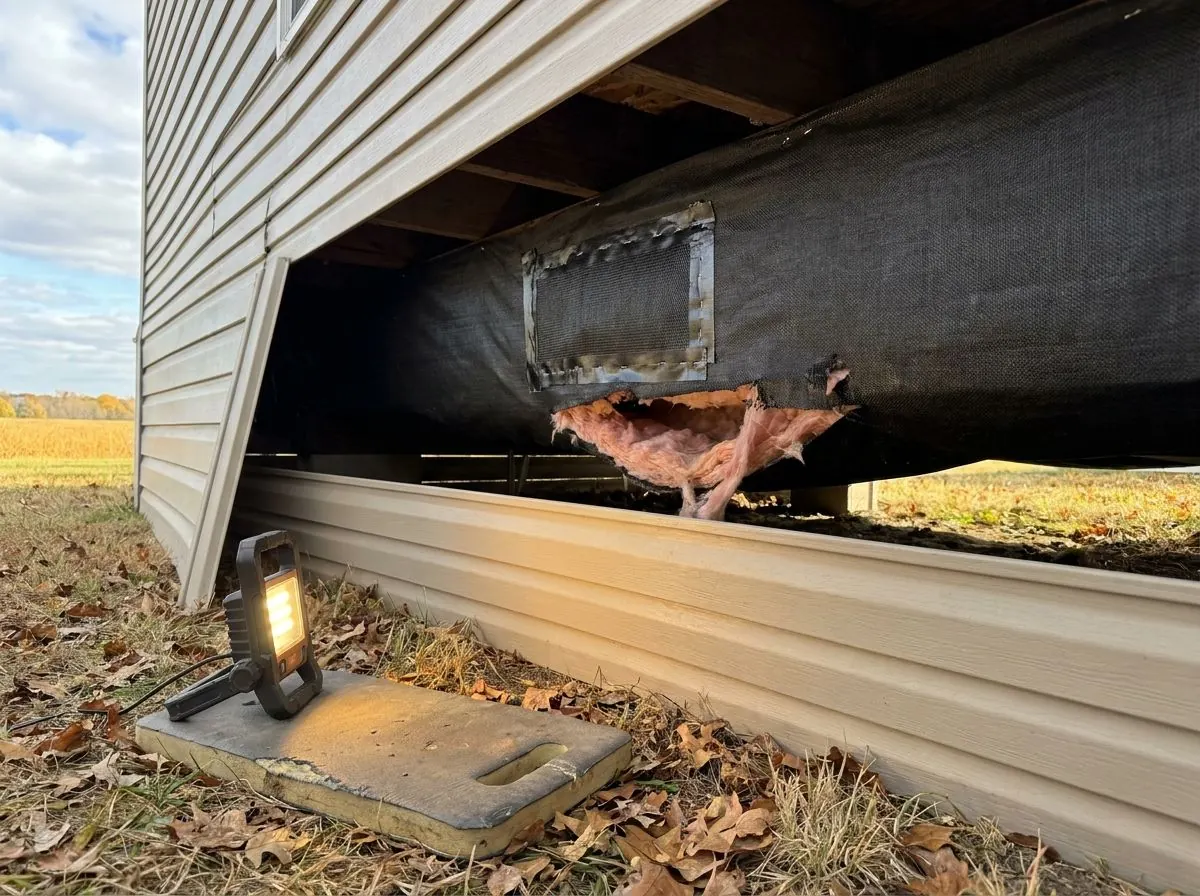
A manufactured home carries its floor insulation in a sealed envelope under the frame. Fiberglass sits between the floor joists, and a flexible bottom board, also called the belly wrap, closes it from below. Ductwork and water lines usually run inside that belly. As long as the bottom board is whole, the insulation stays in place and the pipes sit in a protected space. Once it tears, everything inside it is exposed to the air under the home, which in winter is outdoor air.
Bottom boards get damaged in ordinary ways. Rodents chew through to nest in the insulation. Dogs and cats tear holes to get underneath. Wind finds a loose edge at the skirting and works it open, and plumbing repairs leave a section cut away and never closed. Then the insulation sags or falls onto the ground, the floor above feels cold, and the ducts lose heat and cooling into the crawl area. Owners often discover it after a drafty winter, or when a utility bill suddenly looks wrong.
The worst outcome is a frozen water line. During a long arctic outbreak, such as February 2021, a supply line that sat in a protected belly now hangs in moving air. Heat tape helps only while it works and the line is insulated around it. A freeze can split a pipe, and the leak often shows up only when the weather warms and water starts running into the belly or onto the ground. By then the insulation is soaked and the bottom board is heavy and torn further.
How It Works
Repair starts from underneath. We go under the home, remove wet, contaminated or fallen insulation, and look at the ducts, water lines and heat tape before closing anything up. Damaged sections of bottom board are patched with compatible material, or replaced in larger sections, and fastened and sealed to the frame and rim so the belly is a closed space again. The insulation inside is restored to full depth with batts or blown fill, so the floor and the pipes are both back inside the insulated envelope.
Skirting is the second line of defense. It stops wind from scouring the underside of the home, and closed-cell foam sprayed on its inside face can cut drafts further, but only where the skirting design allows it. Most skirting needs ventilation openings to keep the space under the home dry, and those stay open as designed. A vapor retarder on the ground under the home limits moisture rising from the soil, so we check that it is in place, and restore it where it is missing.
Some things are never covered. Access panels for plumbing and utilities stay clear and openable. Heat-taped water lines, shutoff valves and the frame areas the manufacturer says to leave alone are not foamed over, because a technician needs to see and reach them, and some heat tapes must not be buried. The goal is a belly that is sealed and insulated, with skirting that blocks wind but still vents, and pipes that sit in a protected space rather than in the wind.
How the Job Runs, Step by Step
Inspect the belly and the skirting
We go under the home and map tears, sagging sections, wet insulation and rodent activity. We check where water lines, ducts and heat tape run, how the skirting is built and vented, and whether a ground vapor retarder is in place. Leaks found along the way are flagged first.
Clean out and fix leaks
Fallen, wet or contaminated insulation is removed and bagged. Rodent-contaminated material is wetted down and removed with respiratory protection, never dry-swept. Plumbing or duct leaks are repaired by the right trade before any insulation goes back.
Repair the bottom board
Damaged belly material is patched or replaced with compatible board, fastened to the frame and rim and sealed at the edges. Larger openings get a full new section. Access points around plumbing are left openable rather than sealed shut.
Re-insulate the belly
Batts or blown fill are restored to full depth, so the floor and the water lines are inside the insulated space. Heat tape is left exposed where its maker requires, and ducts are checked for sealed joints and secure connections before the belly is closed.
Seal the skirting where allowed
Where the skirting design allows, closed-cell foam goes on its inside face to cut drafts, with the designed ventilation openings kept clear. The ground vapor retarder is restored if needed, and access panels are left clear for future service.
What Decides the Specification
How much bottom board needs replacing, and what type of material the manufacturer used, decides most of the work. Small holes are patched; long tears or sagging sections are replaced and re-fastened. The belly insulation depth is set by the floor framing, and restoring it fully is usually more valuable than adding foam anywhere else. Where the home has a history of frozen lines, we pay particular attention to that run.
Skirting material and venting set what is possible outside the belly. Vinyl or metal skirting with built-in vents can usually take foam on its inside face away from the vents. Some skirting designs and some foundation setups do not allow it. The manufacturer’s installation instructions and any limits on foam near the frame or tie-downs take priority over our preference, and if they are unclear we leave the area alone.
Oklahoma Code Notes
Manufactured homes are built under the federal HUD Code, not the IRC, and the manufacturer’s installation instructions cover the frame, foundation, skirting and bottom board. Repair work keeps the home consistent with those instructions. The 2024 IRC as adopted in Oklahoma governs site-built homes and additions, and a city or county decides how it treats permitted work on manufactured homes, so check with your city building department, or with the county outside city limits. Foam left exposed on skirting needs the protection its evaluation report lists.
General guidance only. The city building department and the product’s own evaluation report decide what applies to your job.
Around Oklahoma City
Choctaw has many manufactured homes on acreage and semi-rural lots, and the same is true at the edges of the metro around it. Those sites are open to wind from every direction, which is exactly what tears loose skirting and works under a damaged belly. Livestock, dogs and rodents are part of rural living, and every one of them can end up under a home. Older units on these lots often have years of small repairs to the bottom board, each one a seam the wind can open again.
The February 2021 cold was a reminder of how quickly a damaged belly can turn into a burst pipe. A line inside a sealed, insulated belly behind closed skirting sits in still air; a line hanging below a torn bottom board sits in the wind, and that difference is what this work restores. The work is not glamorous, but it is the part of a manufactured home that matters most when the next arctic outbreak arrives.
Often Done Alongside
Crawl Space Encapsulation
Sealed ground liners and perimeter wall foam for damp OKC crawl spaces.
2lb Closed-Cell Spray Foam
Dense 2 lb foam for crawl walls, rim joists, concrete and steel buildings.
Thermal Imaging & Draft Audits
Before-and-after infrared scans that show missing insulation and air leaks.
Where We Do This Work
Mobile Homes: Questions We Get
What is the belly wrap on a mobile home?
Can spray foam stop my mobile home pipes from freezing?
Does the HUD Code limit what you can do?
How do I know if my bottom board is damaged?
Do I need a permit for insulation work?
Considering Mobile Homes?
Tell Spray Tech Insulation about the job. We will look at it, tell you whether mobile homes is the right fix, and price it in writing.