ROCKWOOL Comfortbatt Mineral Wool Insulation in Oklahoma City
Stone wool thermal batts for exterior wood-framed walls and furred walls against masonry: R-15 in 2x4, R-23 in 2x6, R-30 for ceilings. Water-repellent, noncombustible and stiff enough to stand in the cavity without slumping, so the fit stays tight after the drywall goes on.
The Problem It Solves
A wall batt only works while it fills the cavity, and many batts stop doing that over time. Light, floppy insulation can sag from the top plate, fold at the ends and pull away from studs as the house moves through hot summers and cold snaps. In an older remodel, the bays are rarely a clean 14.5 inches wide, the studs are often full-dimension lumber, and every cut-around a soft batt needs becomes a place where it can fail. The empty strip at the top of a wall is where summer heat walks in.
Moisture is the second worry. In older Oklahoma City houses, exterior walls that get opened during a remodel commonly show staining from old window leaks, roof leaks above a wall, or plumbing that sweated inside a cavity for years. Insulation that soaks up water, holds it and then sags is a poor partner for a wall that has had trouble before, and the next leak, if one comes, will do more damage behind it.
Then there are places where fire behavior matters to the owner. Walls around a fireplace surround, a wall next to a furnace closet or water heater, a garage wall, or the wall behind a kitchen range all make people ask whether the insulation will add fuel. Standard thermal batts are acceptable in those locations when installed correctly, but some homeowners and builders simply want a noncombustible cavity. Getting that choice right while the wall is open is far easier than revisiting it later.
How It Works
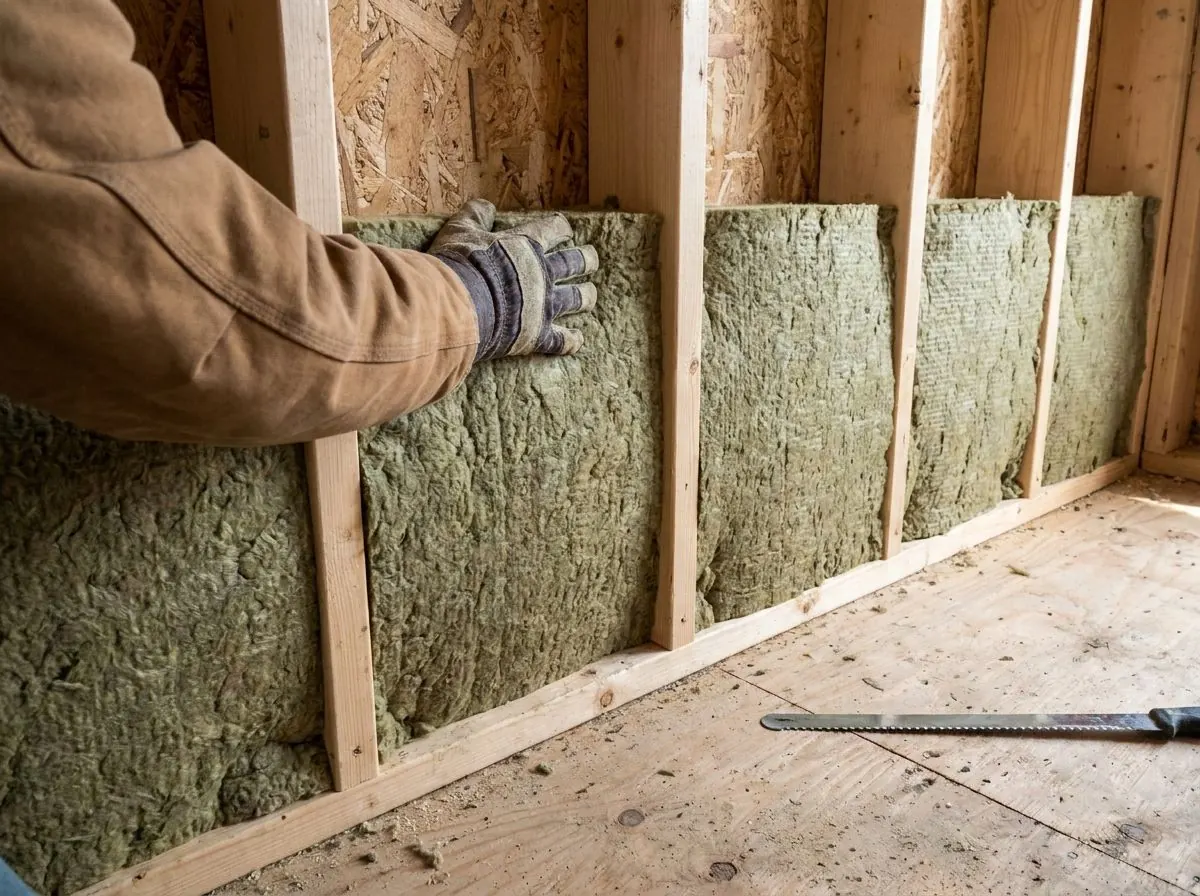
ROCKWOOL Comfortbatt is made from stone spun into fibers and formed into a semi-rigid batt. Because it is stiff, it stands up in the cavity on friction alone and does not slump, fold or pull away from the studs. It is cut with a serrated knife rather than torn, so we can trim it to an odd bay width, notch it neatly around a box, or slice it along its thickness to pass behind wiring, and the cut edges stay crisp. In the irregular framing of an older home, that precision is a large part of the value.
The material is water-repellent, so it sheds liquid water rather than wicking it, and it is vapor-permeable, so a wall can dry through it. It is not a vapor retarder, which in climate zone 3 is usually what you want, since the summer moisture drive in an air-conditioned house runs inward. Stone wool is noncombustible, which is why owners choose it beside fireplaces, mechanical closets and garage walls, and it absorbs sound better than a light batt, which helps on bedroom walls that face a busy street.
How the Job Runs, Step by Step
Open the wall and look at its history
Before ordering, we inspect the open cavities for old water staining, rot, active leaks, wiring condition and the actual stud and bay sizes. In an older house we check for knob-and-tube wiring, which an electrician needs to confirm and deal with before anything covers it. A wall with an active leak gets fixed first, whatever insulation goes in later.
Size the batt to the real framing
Comfortbatt comes in R-15 for 2x4 walls and R-23 for 2x6. Older homes with full-dimension studs or plaster lath can have deeper or uneven cavities, so we measure rather than assume. For a wall furred out against brick or block, the furring depth sets the batt, and the moisture plan for that masonry is settled before we cut anything.
Cut each piece to its bay
Each piece is cut about half an inch over the bay width so it presses gently against both studs. We split the batt around cables, notch it cleanly around boxes and pipes, and trim the ends square to meet the plates. Narrow bays beside windows and over headers get their own measured pieces instead of scraps.
Close the air paths around it
Stone wool slows heat but not air. We seal the top and bottom plates, gaps at window and door rough openings, and holes for wiring and plumbing, and fit gaskets or box seals on exterior-wall electrical boxes. Those are the air barrier details from the code’s installation checklist, and they decide how well the wall actually performs.
Inspect before plaster or drywall
We walk every wall looking for gaps at the plates, edges that have not seated, and boxes left uncovered, and fix them on the spot. On permitted work, the wall is then ready for whatever check the city building department carries out before it is closed, and we record the products and R-values installed for your records.
What Decides the Specification
Framing depth sets the R-value: R-15 in 2x4 walls and R-23 in 2x6 walls, with R-30 for ceilings that will be batted. An R-15 Comfortbatt in a 2x4 wall meets the state’s amended R-15 wall line without deeper framing, which is useful on remodels where adding studs is not practical. Where the target for a ceiling with an attic is R-49, a batt layer usually needs blown fill on top. The remaining decision is fiberglass or stone wool, and that turns on fit, moisture history, fire behavior, sound and cost.
Masonry changes the conversation. Insulating the inside of a solid brick or block wall makes that masonry colder in winter and slower to dry, and older brick that has always been kept warm by the house can respond badly. Stone wool is vapor-permeable and water-repellent, which suits such walls better than many materials, but the right detail depends on the wall: its condition, its exposure, how water is managed outside, and whether a designer has specified a particular approach. We follow the design, and where there is none we explain the trade-offs before you choose.
Oklahoma Code Notes
Under the 2024 IRC as adopted in Oklahoma, with state amendments, climate zone 3 wood-framed walls are listed at R-15 and new ceilings with an attic at R-49. Those values apply to new construction and work covered by a permit, and in an older house they are the sensible benchmark rather than a legal requirement for walls nobody is opening. Climate zone 3 does not require an interior vapor retarder on frame walls, which fits a vapor-permeable stone wool batt well.
Table N1102.5.1.1 is the air barrier and insulation checklist that applies to permitted work: insulation filling the cavity and in contact with the air barrier, sealed plates, sealed penetrations and sealed electrical boxes on exterior walls. Noncombustible stone wool can contribute to tested fire-resistance assemblies, but a rating comes from the listed assembly, not from the batt. The City of Oklahoma City’s Development Services, or the building department of the city you are in, decides whether a remodel needs a permit.
General guidance only. The city building department and the product’s own evaluation report decide what applies to your job.
Around Oklahoma City
Mesta Park remodels are a good example of where Comfortbatt earns its keep. Many of these early-1900s homes have plaster walls, irregular framing, some brick masonry, and a history of roof and window leaks that shows up as stained studs once a wall is opened. When an owner takes a wall back to the framing to rewire, re-plumb or open a kitchen, a stiff, water-repellent batt cut precisely to odd-sized bays is a natural fit. Historic preservation review can apply to exterior changes in the district, so we keep our work inside the wall unless told otherwise. Crown Heights bungalows from the 1920s to 1940s show the same full-dimension studs and inconsistent bays when walls come down.
Often Done Alongside
Fiberglass Thermal Batts
R-13 to R-21 wall batts, fitted tight for OKC new builds and remodels.
ROCKWOOL Safe’n’Sound Acoustic Batts
Safe’n’Sound batts for quieter interior walls, ceilings and floors.
Exterior Continuous Insulation (CI)
Mineral wool and XPS boards outside the framing, behind rainscreen or brick.
Where We Do This Work
Comfortbatt: Questions We Get
Is Comfortbatt worth the extra cost over fiberglass?
Can Comfortbatt go on the inside of an old brick wall?
Will a mineral wool wall stop a house fire?
Will stone wool batts help with street noise?
How do I know the work was done properly?
Considering Comfortbatt?
Tell Spray Tech Insulation about the job. We will look at it, tell you whether comfortbatt is the right fix, and price it in writing.